
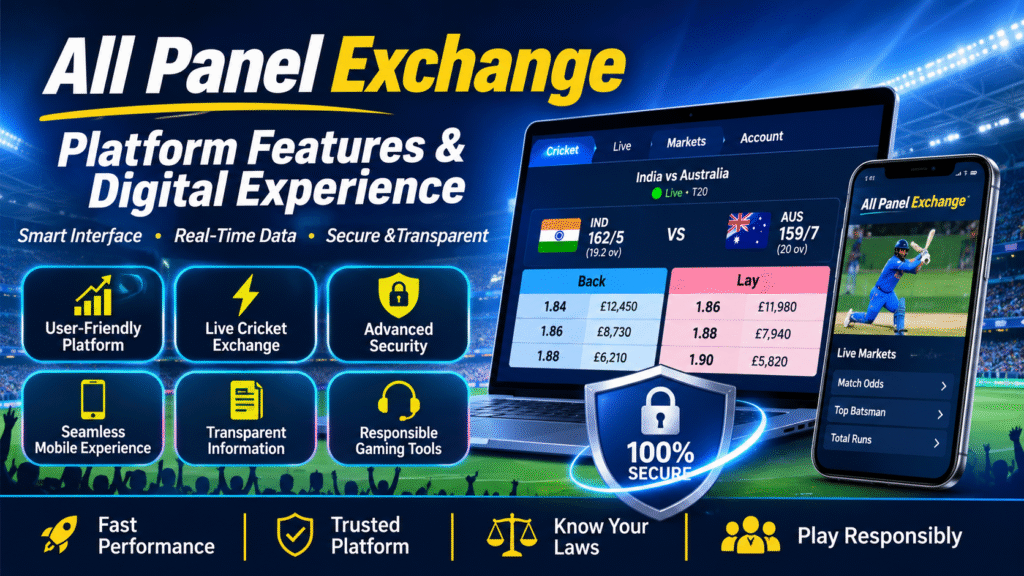
Explore our complete platform overview of All Panel Exchange. Learn about platform usability, website experience, All Panel Exchange ID security, and legal rules.
Modern sports fans interact with live matches very differently than they did a decade ago. Instead of relying solely on television broadcasts and static newspaper box scores, millions of users now browse interactive web portals that combine live match telemetry, statistical dashboards, and peer-to-peer market interfaces under one roof.
In search queries across South Asia and beyond, All Panel Exchange has emerged as a widely searched term among users looking to understand how multi-panel sports ecosystems operate. When people research an All Panel Exch Platform, they are rarely looking only for a login screen—they want to know how the interface works, what platform usability standards to expect, how data flows in real time, and what legal or financial risks apply.
This guide provides an objective, user-centered platform overview examining the architecture, interface design, website experience, account lifecycle, and regulatory boundaries of an All Panel Exchange ecosystem.
Platform Overview: What Defines an All Panel Exchange Ecosystem?
At its core, an All Panel Exchange is a unified web environment that aggregates multiple interactive panels—such as live sports markets, match scoreboards, statistical feeds, and account management tools—into a single digital sports platform. Rather than forcing a visitor to navigate disconnected websites for fixtures, market prices, and wallet records, the multi-panel model brings those modules into one synchronized workspace.
From a software architecture perspective, an All Panel Exch Platform typically consists of four connected layers:
- The Presentation Layer (Front-End Interface): The visual dashboard users see in their desktop or mobile browser, including navigation menus, odds grids, scorecards, and bet slips.
- The Data & Telemetry Layer: Real-time feeds that stream ball-by-ball cricket updates, session timers, and market price movements.
- The Matching & Ledger Engine: The back-end system that pairs opposing user positions in an exchange market and updates available balances.
- The Identity & Compliance Layer: The authentication gateway tied to an All Panel Exchange ID, alongside verification checks, security logs, and responsible-use controls.
For visitors seeking foundational background details, checking an established All Panel Exchange information hub is often the starting point for reviewing general All Panel Exch Information before evaluating any specific service.
Inside an Online Cricket Exchange: How Market Interfaces Work
To understand the website experience of an All Panel Exchange, it helps to look closely at its flagship component: the online cricket exchange. Unlike a conventional fixed-odds bookmaker—where the operator sets the price and acts as the counterparty to every user—an exchange functions like a financial order book.
Back vs. Lay Mechanics on Screen
On an online cricket exchange interface, each selectable outcome (such as Team A winning a T20 match or a batter reaching a milestone) displays two primary columns:
- Back (Typically Highlighted in Blue): Selecting this option means backing an outcome to happen—similar to buying an asset. If the event occurs, the user wins based on the matched decimal price.
- Lay (Typically Highlighted in Pink): Selecting this option means laying an outcome—acting like the seller who predicts the event will not happen. If the outcome fails to occur, the layer keeps the backer’s stake; if it occurs, the layer pays out the calculated liability.
Below each price box, well-designed platforms display market liquidity—the exact monetary volume currently available to be matched at that specific price tick. Showing available volume prevents users from assuming unlimited liquidity exists at a displayed rate.
How Exchange Interfaces Differ from Standard Sportsbooks
| Interface Dimension | Traditional Fixed-Odds Sportsbook | Online Cricket Exchange Interface |
|---|---|---|
| Pricing Source | Set unilaterally by the operator’s traders | Driven by supply and demand among users |
| Visual Columns | Single column of odds per selection | Dual columns (Back and Lay) with market depth |
| Liquidity Visibility | Hidden behind operator stake limits | Displayed openly beneath each price tier |
| Order Status | Accepted or rejected immediately | Can be Matched, Unmatched, or Partially Matched |
| In-Play Suspension | Brief odds lock during key moments | Automated market suspension on every ball delivery or review |
| Fee Structure | Built into the overround (margin) | Typically a transparent commission on net market winnings |
Understanding this layout is essential to platform usability. A cluttered or poorly labeled order book can easily confuse first-time visitors, whereas a clean interface clearly separates matched volume from unmatched offers.
Website Experience: Visual Hierarchy, Speed, and Interface Design
In a fast-moving sport like Twenty20 cricket—where a single over can shift match probabilities dramatically—website experience is not merely about aesthetics. It directly affects whether users can read information accurately, navigate without frustration, and avoid costly input errors.
1. Visual Hierarchy and Typography
Effective digital sports platform design relies on strict visual hierarchy. When dozens of numbers update simultaneously on a screen, poor typography creates cognitive overload.
High-quality interfaces address this through:
- Tabular Numerals: Using monospaced or tabular figures so that when odds change from
1.84to1.86, the digits align vertically without causing neighboring columns to jitter. - Clear Color Contrast: Ensuring sufficient contrast between text and background colors so numbers remain legible both in bright daylight and in dim evening rooms.
- Logical Grouping: Separating pre-match markets, live in-play markets, and fancy/session markets into distinct, clearly labeled tabs rather than stacking everything into one endless scroll.
2. Page Load Speed and Layout Stability
When live scoreboards and market feeds stream continuously over WebSockets or APIs, front-end performance becomes critical. According to web engineering standards documented on web.dev, two metrics heavily influence user trust and accuracy:
- Interaction Latency: How quickly the interface responds when a user clicks a tab, opens a scorecard, or adjusts a stake field. Sluggish interfaces cause users to click twice, leading to duplicate actions.
- Cumulative Layout Shift (CLS): If a banner, ad, or late-loading scoreboard pushes market buttons downward right as a user taps the screen, accidental clicks occur. Well-engineered platforms reserve fixed container heights for scorecards and banners so buttons never jump unexpectedly.
3. Desktop vs. Mobile Web Ergonomics
Today, the majority of traffic to any All Panel Exch Platform comes from mobile browsers rather than desktop computers. Adapting a data-dense exchange grid onto a 6-inch smartphone screen requires thoughtful responsive design:
- Sticky Scoreheaders: Keeping the live score, current run rate, and overs pinned to the top of the viewport while the user scrolls through markets below.
- Collapsible Bet Slips: Using a bottom drawer that expands only when a selection is tapped, preserving vertical screen space.
- Thumb-Zone Navigation: Placing primary navigation icons (Home, Live, Markets, Wallet, Account) within easy reach of a single thumb at the bottom of the screen.
Platform Usability: Navigation, Accessibility, and Error Prevention
While website experience covers how a site looks and performs, platform usability measures how effortlessly and safely a person can accomplish their goals without confusion or mistakes.
Intuitive Search, Filtering, and Personalization
A busy digital sports platform may list hundreds of events across international Test series, One-Day Internationals, franchise T20 leagues, and other sports. Strong usability features help users cut through that noise:
- Tournament & Format Filters: Filtering matches by league (e.g., international tours vs. domestic T20s) or status (Live Now, Starting Soon, Upcoming).
- Favorites & Watchlists: Allowing users to star specific fixtures so they appear at the top of the dashboard without repeated searching.
- Quick-Switch Panel Navigation: Moving smoothly between live score analytics, open positions, and account settings without losing page state or forcing a full browser reload.
Built-In Error Prevention Safeguards
Human error is one of the biggest risks on any real-time transaction interface. Good platform usability builds protective friction into critical actions:
- Pre-Confirmation Summaries: Before any action is finalized, the slip should clearly display the selected outcome, price, stake, and exact maximum liability in plain numbers.
- Customizable Stake Presets: Letting users pre-configure small, fixed unit buttons rather than typing numbers manually under time pressure.
- Confirmation Toggles: Requiring an explicit “Confirm” tap—and warning users if they disable one-click safeguards—prevents pocket-taps or accidental double-clicks.
- Clear Validation Messages: If a user enters a value outside permitted limits or loses internet connectivity, the interface should display an immediate, plain-English explanation rather than an obscure technical error code.
Accessibility and Inclusive Design
True platform usability also accounts for diverse user needs. Accessible platforms support keyboard-only navigation, allow browser font scaling without breaking layouts, and never rely solely on color to convey meaning. For example, pairing blue/pink or green/red indicators with clear text labels (“Back” / “Lay” or “Settled” / “Pending”) ensures users with color-vision deficiency can read every screen accurately.
Understanding the All Panel Exchange ID and Account Lifecycle
Across user discussions, the All Panel Exchange ID is frequently mentioned as the central credential that ties the entire multi-panel environment together. Looking at the All Panel Exchange ID through the lens of digital identity management clarifies how modern platforms handle access, security, and personalization.
Unified Session State
In older web architectures, users sometimes needed separate logins for sports markets, live statistics, and wallet history. On a modern All Panel Exch Platform, a single All Panel Exchange ID acts as a unified session token. Once authenticated, the user’s preferences—such as preferred odds format, saved watchlists, notification settings, and ledger history—remain synchronized across panels.
Identity Verification (KYC) and Account Integrity
On legitimate, regulated platforms, creating an account ID is only the first step. Know Your Customer (KYC) and age-verification workflows exist to prevent underage access, identity theft, and financial fraud. From a user-experience perspective, a trustworthy verification flow includes:
- Clear Document Checklists: Explaining upfront which government-issued photo IDs or address proofs are accepted and why they are required.
- Encrypted Upload Portals: Allowing users to submit documents directly through a secure HTTPS interface rather than sending sensitive photos over unencrypted messaging apps.
- Transparent Review Timelines: Showing real-time verification status (Pending, Under Review, Verified) inside the account profile.
Account Security and Hygiene
Because a single All Panel Exchange ID connects to personal data and account balances, strong authentication is non-negotiable. Users evaluating any digital sports platform should look for:
- Two-Factor Authentication (2FA): Support for authenticator apps (TOTP) or hardware security keys, which are far more resistant to SIM-swapping than SMS codes alone.
- Session & Device Management: A visible log showing recent login timestamps, IP locations, and browser types, with a one-click option to log out all other active sessions.
- Domain Verification Awareness: Phishing sites frequently mimic popular brand names using slight spelling variations. Users should always verify the exact domain address—such as bookmarking the All Panel Exch Platform information portal—rather than clicking unverified links forwarded on social media.
All Panel Exch Information: Data Quality, Live Telemetry, and Transparency
Information is the backbone of any digital sports platform. Users rely on All Panel Exch Information—ranging from live scorecards to market settlement rules—to understand what is happening on the field and how the platform operates.
Understanding Broadcast Delay vs. Live Telemetry
One of the most important technical realities in online cricket is latency. Television broadcasts and over-the-top (OTT) video streams typically carry a delay of anywhere from 5 to 30 seconds due to video encoding, satellite uplinks, and content delivery network (CDN) buffering.
By contrast, official ball-by-ball scoring feeds used by sports data providers update within one to two seconds of the on-field event. On an online cricket exchange, this means the scoreboard and market status on screen may reflect a wicket or boundary before a viewer sees it on their TV stream. Transparent platforms explicitly inform users about broadcast lag so nobody mistakes normal streaming latency for a platform glitch.
Documentation, Rulebooks, and Audit Logs
High-quality All Panel Exch Information goes beyond live scores. A trustworthy platform publishes clear, accessible documentation covering:
- Sport-Specific Settlement Rules: How rain-affected matches are settled under the Duckworth-Lewis-Stern (DLS) method, what happens if a match is abandoned before a minimum number of overs are bowled, and whether Super Overs count toward “Match Odds.”
- Technical Outage Policies: Clear rules explaining how unmatched or active positions are handled if a data feed drops or a server experiences unplanned downtime.
- Timestamped Activity Logs: Every action—login attempts, market selections, settlements, and balance adjustments—should be recorded with exact UTC/local timestamps so users can review their own history objectively.
Wallet Interface, Exposure Calculation, and Financial Transparency
For users interacting with any real-money All Panel Exch Platform, the wallet interface is where platform usability and financial clarity matter most. Poorly explained balance figures are a leading source of user confusion and support disputes.
Available Balance vs. Net Exposure
In a standard e-commerce wallet, you have one number: your balance. In an exchange environment—especially when laying outcomes—platforms must calculate exposure (the maximum potential liability across open positions). A well-designed wallet header separates three distinct figures:
- Total Ledger Balance: The settled funds currently held in the account.
- Current Exposure (Locked Margin): The portion of funds temporarily reserved to cover open liabilities on unsettled markets.
- Available Balance: The remaining funds free to be used or withdrawn.
Additionally, smart exchange interfaces calculate net market exposure when a user holds offsetting positions in the same market, ensuring users are not over-charged margin when their net risk is reduced. Displaying a clear breakdown of how exposure is calculated builds user confidence and prevents surprise rejections.
Transaction Records and Export Tools
Financial transparency also requires clean record-keeping. Users should be able to filter their transaction history by date range, market type, or transaction category (deposits, withdrawals, commissions, settlements) and export statements in CSV or PDF format. Having downloadable statements is not only helpful for personal budgeting—it is essential for accurate tax reporting.
Legal, Regulatory, and Tax Awareness
Because All Panel Exchange topics touch directly on personal finances and statutory law, understanding the legal landscape is critical. Online betting and gaming laws are not uniform; what is licensed in one country may be strictly prohibited in another.
The Legal Framework in India
In India, gambling and betting fall primarily under the State List (Entry 34 of List II) of the Seventh Schedule of the Constitution, meaning individual state governments hold the authority to regulate or prohibit betting within their borders:
- Central & State Statutes: The colonial-era Public Gambling Act, 1867 (accessible via the India Code legislative portal) prohibits operating or visiting physical gaming houses, and most Indian states have enacted their own state-level adaptations. Several Indian states have enacted strict restrictions targeting online real-money betting and wagering. Gaming laws and their interpretation can change, so check the current law applicable to your location.
- Information Technology Rules & Platform Blocking: Under Section 69A of the Information Technology Act, 2000, and the IT (Intermediary Guidelines and Digital Media Ethics Code) Rules administered by the Ministry of Electronics and Information Technology (MeitY), the Government of India can block access to websites in accordance with applicable legal procedures.
- Banking & Foreign Exchange Rules: Under the Foreign Exchange Management Act (FEMA) and guidelines issued by the Reserve Bank of India (RBI), financial transactions must comply with applicable foreign exchange and payment regulations.
- Taxation Obligations: Indian tax treatment depends on the type of activity and the law in force. Sections 115BBJ and 194BA of the Income Tax Act address taxation and tax deduction for net winnings from online games. Consult the Income Tax Department of India or a qualified tax professional for current requirements. GST treatment is also subject to the applicable law and transaction classification.
International Regulatory Standards
Outside India, regulatory treatment varies widely. In jurisdictions such as the United Kingdom, Malta, and several U.S. states, online sports exchanges may operate legally under specific statutory licensing frameworks. For instance, operators licensed by the UK Gambling Commission must follow applicable customer protection, anti-money-laundering, and responsible-gambling requirements.
Key Takeaway: Never rely on a website’s marketing claims or social media promoters to judge legality. Always verify the laws applicable in your specific state or country and consult a qualified legal or tax professional if you have questions.
Digital Wellbeing and Responsible Gaming Safeguards
Any honest platform overview of a digital sports platform must address behavioral risk. Live cricket matches are emotionally intense, fast-paced, and filled with momentum swings—making impulsive decision-making a serious hazard when real money is involved.
Product Design Features That Protect Users
Responsible platforms embed user-protection tools directly into the website experience rather than burying them in fine print:
- Deposit & Loss Caps: Allowing users to set hard daily, weekly, or monthly limits on how much money they can add or lose, with mandatory waiting periods before any limit increase takes effect.
- Reality Checks (Session Timers): Automated on-screen alerts that pause activity every 30 or 60 minutes to show how long the user has been logged in and their net session position.
- Time-Out & Self-Exclusion Controls: One-click options to lock an account for a short cooling-off period or permanently self-exclude.
- Stake & Liability Warnings: Visual prompts when a user attempts to enter a stake significantly higher than their historical average.
Recognizing Warning Signs & Finding Support
Problematic engagement often develops gradually. Warning signs include:
- Chasing losses by increasing stakes after an unfavorable match result.
- Spending more time or money on a platform than originally planned.
- Hiding screen activity, transaction statements, or time spent online from family members.
- Borrowing money or dipping into essential household, education, or emergency funds.
- Feeling irritable, anxious, or restless when unable to check live scores or markets.
If you or someone you know experiences these signs, confidential support resources include:
- United Kingdom: BeGambleAware and GamCare.
- United States & International: The National Council on Problem Gambling (NCPG) provides support resources and information about helplines.
- India: Tele-MANAS, the Government of India’s national mental health helpline, provides free 24/7 support at 14416 or 1-800-891-4416.
Practical Evaluation Rubric: How to Audit Any Digital Sports Platform
Before trusting any website with your personal details, time, or finances, use this six-point rubric to evaluate its platform usability, website experience, and trustworthiness:
| Evaluation Area | What a Trustworthy Platform Shows | Red Flags to Avoid |
|---|---|---|
| 1. Licensing & Legal Clarity | Clearly states corporate entity, registered address, and valid regulator license number | Anonymous ownership, vague “international license” claims, or no legal terms |
| 2. Account & ID Security | Self-service registration, HTTPS encryption, mandatory KYC, and app-based 2FA | Accounts issued informally via WhatsApp/Telegram agents with shared passwords |
| 3. Platform Usability | Clean layout, zero button-jumping (CLS), clear Back/Lay labels, and confirmation prompts | Cluttered screens, broken mobile layouts, or one-click actions with no preview |
| 4. All Panel Exch Information | Detailed sport settlement rules, DLS policies, broadcast delay notices, and audit logs | Missing rulebooks, unexplained market voids, or discrepancies with official scores |
| 5. Financial Transparency | Named, regulated payment rails, clear exposure calculations, and downloadable CSV statements | Pressure to pay personal bank accounts, hidden withdrawal fees, or delayed payouts |
| 6. Responsible Gaming Tools | Visible limits, reality checks, cool-off controls, and helpline links | No limit tools or aggressive messages encouraging higher stakes |
Frequently Asked Questions (FAQs)
1. What is the difference between an All Panel Exchange and a regular sports website?
A regular sports website typically offers either static news/scores or fixed-odds betting where the operator sets all prices. An All Panel Exchange is a term used for a multi-panel environment that may combine live cricket information, interactive market interfaces, and account management into a single digital sports platform. Actual features vary by provider.
2. Why is layout stability important for website experience on an online cricket exchange?
On an online cricket exchange, prices and match states may update frequently. If a website suffers from poor layout stability—where banners or scorecards load late and shift buttons downward—a user might accidentally tap the wrong control. Good front-end engineering keeps important interface elements stable.
3. How does an All Panel Exchange ID work across different platform sections?
An All Panel Exchange ID may function as a single sign-on credential within a platform’s ecosystem. Depending on the provider, it can link authentication status, security settings, saved preferences, and account records across different sections.
4. Why do live scores on a digital sports platform sometimes appear faster than TV or streaming video?
Live television and internet video streams undergo video compression, encoding, and content-delivery buffering, creating a natural broadcast delay. Official ball-by-ball scoring feeds transmit lightweight text data, which can reach a scoreboard before the corresponding video appears.
5. What should I check in All Panel Exch Information before using any platform?
Always read the platform’s market settlement rules (especially for rain-affected or abandoned cricket matches), privacy policy, KYC verification requirements, fee structure, and legal jurisdiction clauses. Avoid any site that hides its terms or relies on informal third-party agents for customer support.
6. Are winnings from online gaming platforms taxable in India?
Tax treatment depends on the nature of the activity and the applicable law. Sections 115BBJ and 194BA of the Income Tax Act address taxation and TDS on net winnings from online games. Check current government guidance and consult a qualified tax advisor for your circumstances.
Conclusion
Understanding an All Panel Exchange requires looking past surface-level buzzwords to examine how the technology, interface design, and regulatory rules actually work. From the dual-column order book of an online cricket exchange to the responsive layouts, error-prevention safeguards, and latency management that define platform usability and website experience, a well-built All Panel Exch Platform should prioritize clarity, speed, and user control.
At the same time, technology never overrides legal boundaries or financial risk. Reviewing transparent All Panel Exch Information, protecting your All Panel Exchange ID with strong authentication, verifying the laws in your jurisdiction, and understanding responsible-use tools are essential steps for every reader.
For general reference and further information, visit the All Panel Exchange information website and independently verify any claims about services, features, security, and legal compliance before relying on them.